
Finding Brazos County Residents
Every Brazos County record answers its own question. Owner and parcel questions begin at the appraisal roll. Title changes live in the County Clerk's index. A past household shows up better in an old directory, a census page, newspapers, or an archive collection. Voter files are date-specific registration records, not street rosters. For city records, first decide whether the address or event falls in Bryan, College Station, or unincorporated Brazos County. Keep a lead separate from proof. A parcel names an owner or a mailing recipient, not necessarily the occupant. A deed names parties and a filing date, not a present home. A historical book places someone in one listed edition, not across a decade. A careful method holds those distinctions in place while the search widens.
- Start with BCAD when a name or parcel address is known, and save the property or geographic ID and legal description.
- Check the County Clerk’s official-record index for the named party, deed, lien, subdivision, or legal description.
- Use Texas voter status only to test a dated registration question and respect protected-address rules.
- For a past household, compare the Carnegie directory and archive layer with a nearby census or newspaper date.
- Request a specific existing record through the correct custodian when the public portal stops short.
Brazos County Offices Behind Resident Records
Three offices anchor a Brazos County residents directory search. The County Clerk keeps land records, marriage records, probate filings, and civil filings. It also holds other county papers. Brazos Central Appraisal District, called BCAD, maintains the appraisal account and its property-search layer. The Elections office handles local registration, while the statewide portal covers individual status lookup. Each office serves a distinct purpose. A dead end at one counter settles nothing at the next.
Brazos County Elections
300 E. William J. Bryan Pkwy., Suite 100
Bryan, TX 77803
979-361-5770
Parcel layers, deeds, and title records belong with the address-by-address chain. That work lives on the Brazos County street directory route instead of this page.
BCAD Records for Brazos County Names
BCAD is the fastest official start for a property-linked name or street in Brazos County. Its public search opens owner, address, and ID fields plus advanced concepts. Searchable fields include Owner Name, Street Number, Street Name, Property ID, Owner ID, and Geographic ID. Legal-description tools such as subdivision and abstract sit alongside tax year and other appraisal filters. Entering a simple street name or owner form can narrow a broad result first. Then the parcel record itself becomes easier to read.
| Field | Use | Important limit |
|---|---|---|
| Owner Name | Finds an appraisal owner/account | Owner and occupant can differ |
| Street Number and Street Name | Locates a parcel address | Do not add unit numbers to the Street Name field |
| Property or Geographic ID | Preserves the parcel key | Use it with the legal description |
| Tax Year | Anchors appraisal data in time | Preliminary values can change in review |
A situs address marks the physical parcel. A mailing address is where notices go. Neither one alone proves the owner lives there. Keep both forms distinct, along with the tax year, before moving on to a deed or a historical directory.
Brazos County Deed Index Searches
Brazos County deed records begin in 1841, according to the County Clerk. The Official Records advanced search accepts party names, grantor, grantee, recorded and instrument date ranges, document type and number, book, volume, page, lot, block, legal description, and document-image terms. It also takes the grantor and grantee roles. Quick Search adds an index-only choice or index plus full-text OCR. The public index is a strong trail. The portal publishes no stated online cutoff year. Coverage depth should be confirmed before relying on the earliest books.
| Grantor | The party transferring an interest in a recorded instrument. |
|---|---|
| Grantee | The party receiving an interest in that instrument. |
| Recorded date | The date the clerk filed the document, which can differ from the instrument date. |
| Index | A searchable record of document details; it is not necessarily the document image. |
Images and ordering may require an account or payment. A plain copy costs $1 per page. A certified legal-instrument copy costs $1 per page plus $5 for certification under the county fee page. When an older book is not online, the fallback is the Clerk counter, a copy request, or relevant microfilm and archive holdings.
Brazos County Current Resident Roll Sources
Current Brazos County resident sources are purpose-built records, not one universal directory. The appraisal roll ties an owner to a parcel. The deed index names parties to recorded instruments. My Voter Portal can test registration information for one person. Court, vital, and city sources answer even narrower questions. Ask what a result can establish, and on what date.
| Current source | What it can show | Custodian | Access |
|---|---|---|---|
| BCAD appraisal roll | Owner/account, parcel, situs and mailing details | BCAD | Public property search |
| Official-record index | Parties to deeds and other recorded documents | County Clerk | Public index; image access may vary |
| My Voter Portal | Registration status information | Texas Elections | Individual lookup |
| County roster archive | Dated roster publications | Brazos County Elections | Snapshot files |
| Municipal record systems | Place, permit, cemetery, or case clues | Relevant city custodian | Record-specific |
Need one person rather than a comparison of sources? The Brazos County resident lookup workflow keeps name variants, dates, and role differences in view.
Brazos County Voter Lookup Limits
Texas My Voter Portal takes first name, last name, county, date of birth, and ZIP. Those fields locate registration information. Choose Brazos County when that is the correct registration county. ZIP narrows a query. It does not prove a physical residence. The VUID serves update and verification pathways, not as a reason to disclose personal data. The county also posts dated roster archives. Those work best treated as historical administrative snapshots.
| Portal field | Format | Why it matters |
|---|---|---|
| First and last name | Text | Try spelling variants carefully |
| County | Selection | Separates local registration jurisdictions |
| Date of birth | Date or text input | Helps distinguish similar names |
| ZIP | Text | Supports narrowing, not residence proof |
| VUID | Identifier | Used for update or verification functions |
Texas Election Code rules protect some information and limit how voter lists are used. Protected people may have suppressed address information. No record should be combined with other sources to defeat that protection.
Brazos County Court Record Portals
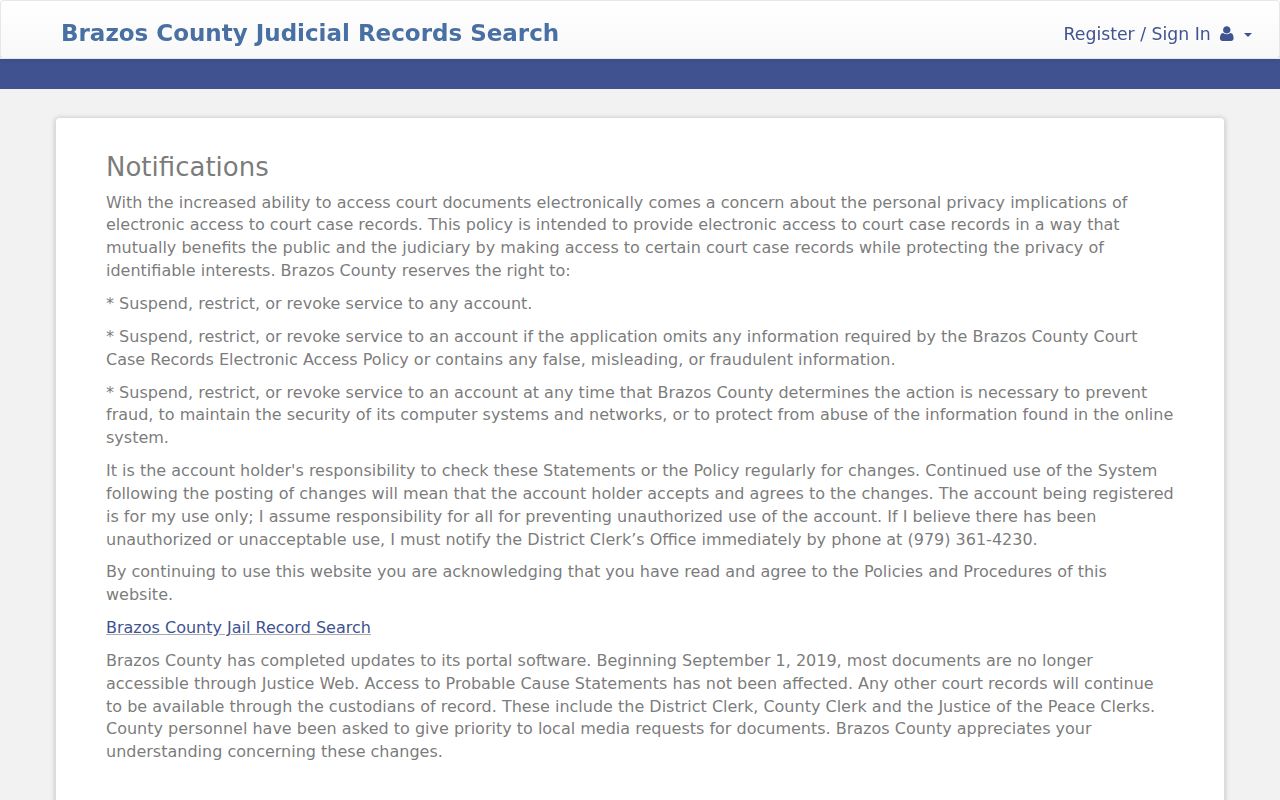
The Brazos Judicial Records portal offers two search tools. Search Hearings lets a visitor filter by location, hearing type, case number, party, business, attorney, bar number, judicial officer, and date range. Smart Search covers current and past inmates. Refine it by case number, case type, or judgment. The portal needs JavaScript and cookies to run, so results may not render in a plain-text browser.
Justice Web does not carry most documents filed after September 1, 2019. Probable-cause statements are the exception. Custody stays split among the District Clerk, County Clerk, Justice of the Peace clerks, and municipal courts. A name on a filing shows a case connection only. It does not establish where someone lives now. Sealed, juvenile, expunged, and victim records may stay protected from public view.
The Judicial Records landing screen shows both search entry points on the official portal page. Both appear together there for a quick start.
A gap online is not proof a paper file is missing. Ask the clerk who holds the case for a specific filing, date, or copy instead of reading a portal gap as absence.
Brazos County Vital Record Custodians
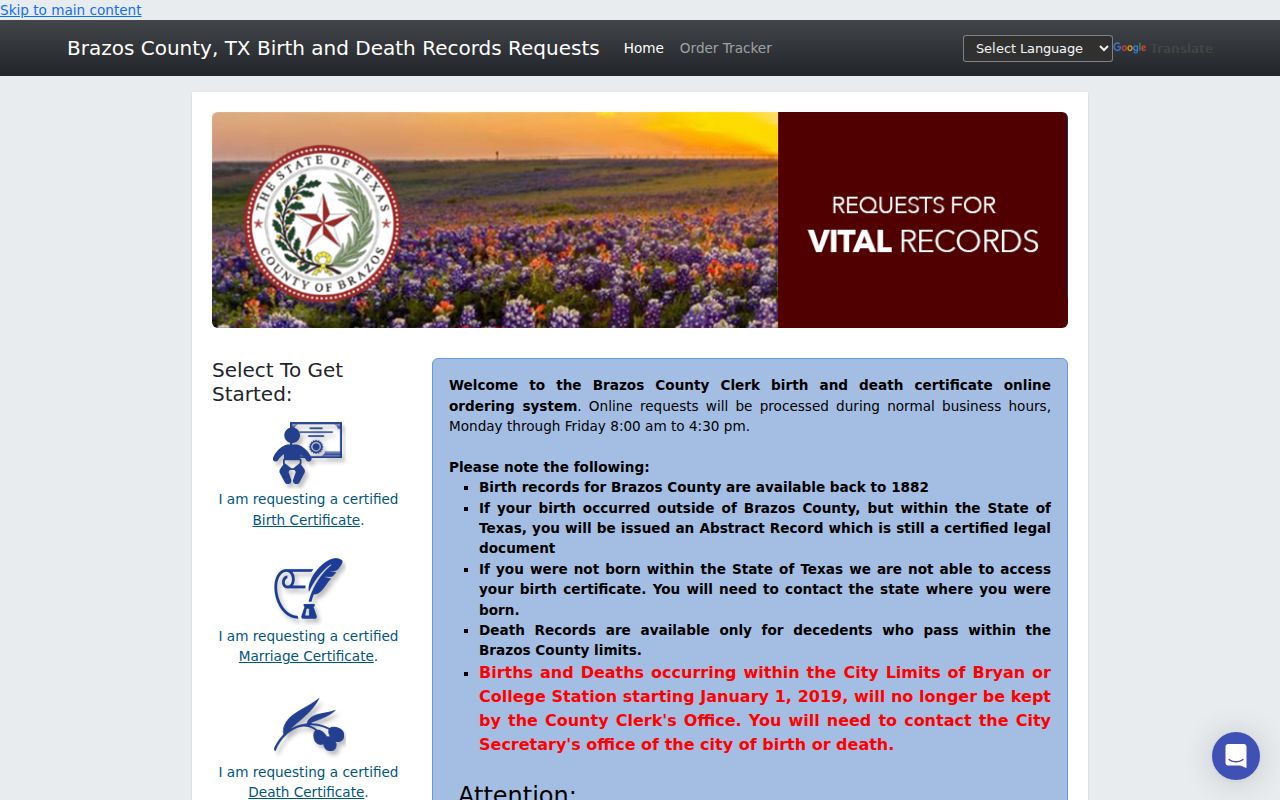
Vital records in Brazos County split by event type, event city, record age, and who may request them. The County Clerk’s Permitium ordering portal handles certified county birth, marriage, and death orders. It is an ordering route, not a public name index. County births reach back to 1882. Events inside Bryan or College Station from January 1, 2019 go to that city’s City Secretary.
Texas DSHS runs the statewide index and copy paths. Births stay confidential for 75 years and deaths for 25 under Texas Government Code §552.115. The digital birth index starts in 1925, the death index in 1965, and earlier microfiche reaches back to 1903. Marriage index coverage is public from 1966. Divorce coverage begins in 1968. A statewide index is a lead, not a certified record.
The Permitium ordering portal shows the county’s certified-record route. It is not an open residents directory.
A 1969 fire destroyed Bryan’s earlier city birth originals. For pre-1969 births, treat the County Clerk and DSHS routes as the likelier sources of a usable record.
Texas PIA Requests in Brazos County
The Texas Public Information Act opens existing records, not a right to make a custodian build a new residents directory. Brazos County takes requests through its online public-information portal, plus mail, email, and fax. The form asks for contact details and a clear description. Delivery options include copies and pickup. Be specific. Narrow each request to a record type, street address, date range, case number, or document number.
The County Judge handles requests. Records held by independently elected officials must go to that official directly. The Texas Attorney General requires a governmental body to produce public information promptly or give notice when it cannot comply within 10 business days. Standard copies cost $0.10 per page. Larger requests may draw estimates or other charges.
The Brazos County open-records instructions point to the right portal or written channel. Bryan and College Station run separate municipal routes.
Brazos County Historic Resident Directory Shelf
Historical resident research starts at the Carnegie History Center. City directories sit there with yearbooks, maps, oral histories, microfilm, genealogy books, and local databases. Surviving Bryan-College Station directory runs reach through 1937. The Texas State Library lists later editions at irregular dates from 1951-52 through 1994. Person sections begin with a surname. Street listings start from an address and return that edition’s occupants.
Telephone books are scattered from the 1920s. Census schedules under the federal release rule corroborate a date. Older newspapers and cemetery material also corroborate a date. Deeds and probate files do too. A directory entry can support presence in a given year. It cannot prove title, continuous occupancy, or an unlisted household. Check the edition, collection, and entry-reading method before drawing a household conclusion.
Brazos County Archive and History Sources
Carnegie anchors local archive work for non-A&M research. Texas A&M’s Cushing Memorial Library and Archives adds regional and campus material, from historical telephone directories to publications, maps, and finding aids. Cushing is a depository, not a current community list. Think history, not lookup. College Station’s Project HOLD, begun in 2003, offers digitized city and residential history, photographs, oral histories, videos, and objects.
Use the Carnegie Special Collections for local history holdings. Project HOLD searches by keyword and title, with Advanced and Customize filters, folders, and download or print tools. Keep an object’s collection context and date with the citation. A photograph can show a place or event without naming every resident tied to it. That limit matters.
Note: Older Eagle and Battalion research is usually a microfilm or archive task, while the library’s Eagle database covers 1999 forward online.
Brazos County Address Geography Matters
Addresses in Brazos County get confusing fast. A ZIP code describes one thing. A city label, a parcel number, and a legal description each describe something different. A mailing address may say Bryan or College Station. The property may actually sit in an unincorporated pocket, an ETJ, or an edge ZIP. BCAD separates the physical situs from the mailing address for exactly this reason. The county GIS maps are general reference tools, not legal documents. When you read a historical residents directory entry, keep the place wording exactly as printed. Then check it against modern parcel data or current city limits.
- Parcel
- A tax or appraisal unit identified through a property or geographic ID and legal description.
- Situs address
- The physical location address for a parcel, distinct from the owner’s mailing address.
- Legal description
- The lot, block, subdivision, abstract, or other recorded land description used to join property sources.
- Criss-cross directory
- A street-order directory section that lists occupants by address for its edition.
Street names change over time. Older buildings may have burned, moved, or been replaced entirely, so the lot, block, subdivision, and legal description become the practical bridge whenever a street label alone will not hold still.
Brazos County Official Records Compared
A Brazos County custodian’s index and a commercial residents directory simply answer different questions. The commercial product blends public extracts, marketing data, and old street directory scans. It also adds details users upload themselves. That mix breeds duplicate names and stale addresses. A records office index is narrower by design. It names the source, the date, and the exact request path. For a certified copy, a correction, or real verification, go to the custodian.
| Source type | Strength | Limit |
|---|---|---|
| Official county or state record | Named custodian and documented scope | May be restricted, dated, or incomplete online |
| Historical directory or archive | Dates a household or local context | May omit people and contain edition gaps |
| Commercial lookup category | May provide a starting lead | Not proof; records can be stale or mismatched |
An official record that looks wrong belongs with the custodian who keeps it. A public-information request can pull existing files, but it cannot amend BCAD, Clerk, court, election, or vital-record data.
Brazos County Records From 1841 to 2026
Brazos County’s records run deep. The county was created in 1841 and renamed a year later. It was organized in 1843 and settled its seat at Bryan in 1866. Deed records begin with that founding year of 1841. Older collections add more. They include land and town-lot abstracts from 1879, city additions from 1914, delinquent tax rolls from 1885, and property assessments from 1919. Access to each set depends on the archive route a visitor takes.
A newer layer now sits beside that history. In June 2026, the county announced a Commissioner Court agenda and minutes portal. It includes a Laserfiche archive reaching back to the 1840s. Court minutes can surface names, petitions, road orders, subdivisions, and boundary terms. A conventional residents directory simply does not carry these. The archive metadata and document dates tell a reader when each entry was made.
These features shape any Brazos County lookup. The 1841 deed start, the irregular run of city directories, Bryan’s 1969 vital-record fire, and the 2026 archive all point to the same lesson. Match the question to its custodian and its period.