
Brazos County Previous Residents Sources
A house history has several time layers. Recorded instruments track the parcel and legal title. Appraisal and tax sources supply another ownership signal. Directories, census schedules, newspapers, and obituaries can place people near an address on a date. Sanborn maps and aerials help decide whether the same structure was still present. Read those sources together, because a change in a tax account or listing alone does not prove that one household left on a particular day.
| Source | Years It Covers | Where Held | What It Shows |
|---|---|---|---|
| County deed books and index | Books begin 1841; online cutoff unknown | County Clerk, online index, counter, and copy route | Grantor, grantee, legal description, instrument and recorded dates |
| Land and town-lot abstracts | 1879-current in the historical inventory; additions 1914-current | Historical inventory, archive, tax and BCAD routes | Tract, lot, owner and assessment history |
| Property assessments | 1919-current in the inventory | County archive, Tax Office, and BCAD | Assessed property and value changes, not occupancy |
| City directories | Surviving runs through 1937; 1951-52 through 1994 with gaps | Carnegie, state-library catalogs, and Texas A&M | Street addresses and listed household clues |
| Sanborn maps | Library of Congress item, 1938 to March 1950, 36 sheets | Carnegie, Texas A&M, and Library of Congress | Building footprint, material, and use |
| Federal census | Decennial schedules subject to the 72-year rule | Library databases, National Archives, and online collections | Household, age, birthplace, and neighbor order |
Start with the source nearest the target date. A directory gap means the edition is absent or unlocated, not that the address was empty. A parcel may also contain more than one building, so the legal description and lot or block are steadier keys than a street number alone.
Brazos County Previous Residents Start at the Parcel
Use the BCAD property search to record the current owner or account, property and geographic IDs, legal description, subdivision, lot or block, tax year, and the distinction between situs and mailing address. The situs is the parcel location. The mailing field is where correspondence is sent. Neither field, by itself, establishes that an owner occupied the building.
Then use County or Bryan GIS to compare the street address with parcel geometry. Save the original spelling and any city or ZIP label that appears in the source. A change in city label, a renamed road, a moved structure, or a replacement structure can otherwise make one address look like two different places. The parcel key also helps when an older directory uses a street form that no longer matches modern mail.
Property cards can show value, class, exemptions, acreage, and characteristics where available. Treat a homestead or exemption signal as one dated clue, not final evidence of a household. The current year may change during the appraisal process.
Brazos County Previous Residents Deed Chain
The Brazos County Official Records index is the title trail. Search by party name, grantor, grantee, subdivision, document type or number, legal description, lot, block, book, volume, page, recorded date, and instrument date. The portal separates Index Only from Index & Full Text OCR searching. Its public index is useful for discovery, while image or cart access can require registration or payment.
- Find the current owner as a grantee and copy the legal description, document number, and both relevant dates.
- Identify the seller, called the grantor, and search that person or entity as an earlier grantee in the same legal description.
- Repeat backward while checking name variants, trustees, entities, liens, releases, plats, probate, and inheritance-related instruments.
- When a book or index is not online, ask the County Clerk for the counter, copy, microfilm, or archive route rather than guessing at the missing transfer.
- Grantor and grantee
- The grantor transfers an interest. The grantee receives an interest in the recorded instrument.
- Chain of title
- The sequence of recorded instruments that connects one owner or interest holder to an earlier one for the same property.
- Legal description
- The lot, block, subdivision, abstract, or metes-and-bounds description that identifies land more reliably than a mailing address.
Instrument date and recording date can differ. A deed may be filed after a sale, and probate, marriage, divorce, or a court instrument can alter title without an ordinary sale. That is why a short list of owners is not automatically a complete chain.
Brazos County Previous Residents Beyond the Online Index
County deed books begin in 1841, but the live official-records portal does not state an online cutoff. That gap matters. Do not assume an unreturned portal search means the beginning of local ownership history. The County Clerk's counter and copy route, Carnegie History Center, Texas A&M microfilm, and archive finding aids are the documented fallbacks when an early instrument is outside the visible online run.
Brazos County was created in 1841 and renamed in 1842. Those early county terms can appear in finding aids and historical references, so preserve the wording used by the original source when an address trail reaches its oldest records.
The historical-records inventory also documents land and town-lot abstracts from 1879-current, city additions from 1914-current, property assessments from 1919-current, and delinquent tax rolls from 1885-current. Those are inventory ranges, not a claim that the modern portal displays every year. Compare the inventory with the holding location before drawing a date boundary for prior residents.
The Texas historical-records inventory is the source for this Brazos County previous residents image.
The inventory gives a practical path to older land and assessment series, while the physical holder determines what can be inspected or copied.
Brazos County Previous Residents in Household Records
Directories add people to the parcel trail. The local guide identifies surviving Bryan-College Station directory runs through 1937 and later runs from 1951-52 through 1994 with gaps. Person and street sections can identify a listed address, household clues, and nearby entries. Use the year closest to the recorded transfer, then test the same address in the next available volume. A listed person can be an occupant or other named contact, so it still needs date and role context.
- Place the deed or tax date on a timeline and pull the directory volume nearest that year.
- Check the person section and street section, preserving abbreviations and the printed address exactly.
- Pair the closest available federal census with the directory, noting its release rule and the household date.
- Use obituaries, probate, and newspaper legal notices to mark an endpoint or explain a change, never to fill an unsupported gap.
The Brazos County city directory has the fuller collection and entry-reading context. Here, a directory is used as a dated household layer alongside the address chain, not as a current resident list.
Historical use. Use prior-resident records for lawful family, property, and local-history research. Do not use a historical address trail to stalk, harass, intimidate, or harm anyone.
Brazos County Previous Residents and Building Dates
Sanborn and aerial sources help separate a change in people from a change in the building. The Library of Congress Bryan Sanborn item covers 1938 through March 1950 in 36 sheets. Local holdings describe Bryan mapping from the 1880s onward at irregular intervals. Sanborn sheets show footprint, material, and use, but not occupants. They should be paired with a directory or deed dated near the map.
Bryan GIS lists imagery for 1936, 1940, 1964, 1971, 1973, 1979, 1988, and later years through 2024. A roof or street pattern may show continuity, demolition, or replacement. It cannot identify a resident. When the building changes, shift the investigation from household continuity to parcel and lot or block continuity.
Note: A historic map and a directory can support the same-address timeline, but neither independently proves a person's exact move-in or move-out date.
Brazos County Previous Residents and the 1969 Fire
Bryan's 1969 fire destroyed earlier city long-form birth originals. That loss changes a vital-record search for an older household, but it does not erase every possible source. Check County Clerk books, the DSHS index or verification route, delayed or probate birth evidence, newspapers, church or school material, and the local house-history resources where applicable. Do not promise that a city long-form original survives.
Event place chooses the custodian. County Permitium, Bryan, College Station, and DSHS routes can all matter, especially for city-limits events from 2019 forward. A family residence in Brazos County does not by itself identify the office that holds a birth or death event. Retain both the event city and the residence address in the research notes.
Brazos County Previous Residents Archive Route
Carnegie History Center's TARO finding aids identify family, government, business, and community collections that may contain a name, place, or date not preserved in a directory. A finding aid is an inventory, not an automatic record match. Use its collection, box, and folder information to request the proper material under archive rules.
The TARO finding-aids page is the source for this Brazos County previous residents image.
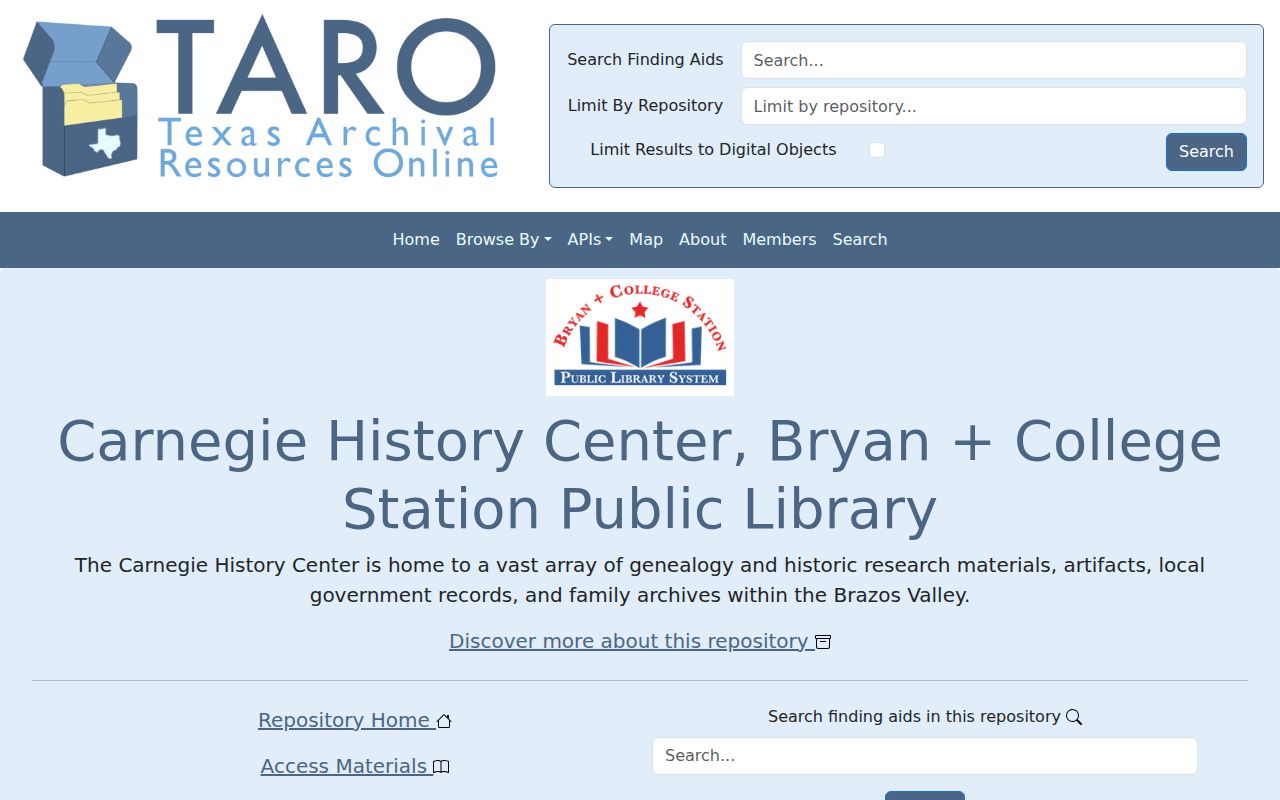
Carnegie and Cushing are useful when the clerk index stops or when directories, tax microfilm, newspapers, photographs, and local manuscripts need to be compared. The house-history method begins with the title abstract or deed and legal description, then branches to tax, directory, census, newspaper, map, cemetery, and probate sources.
Keep a simple date log: source, date represented, address as printed, parcel key, name, role, and what the source actually says. A blank interval remains a blank interval until a dated source fills it.
Brazos County Previous Residents Limits
Previous residents research often ends with an honest uncertainty. A street may have changed name, a house may have burned, moved, or been replaced, and several buildings may share one parcel. Deed books, assessments, directories, census schedules, permits, and newspapers cover different dates and roles. Preserve the original evidence rather than smoothing those differences into a single story.
Public access is access to existing records, not a demand that a custodian create a house history or resident list. Narrow date, address, document, and parcel requests improve the chance of finding a responsive record. Confidential vital, juvenile, sealed, protected, and other restricted material may not be released.